Hello, I’m Lenny and welcome to a 🔒 subscriber-only edition 🔒 of my newsletter. Each week I tackle reader questions about product, growth, working with humans, and anything else that’s stressing you out at the office. Send me your questions and in return, I’ll humbly offer actionable real-talk advice 🤜🤛
Q: It'd be great if you can share some advice about increasing retention. Also, please some companies who are doing this very well.
If you read my previous post about what good retention looks like and came away thinking “On no, my retention is too low! What should I do?” – this post is for you.
Below I’ll share an exhaustive set of strategies to increasing your product’s retention, including dozens of examples from companies big and small. Here’s a preview:

Be warned though — significantly increasing retention is hard.

Why is that? Well, because people are busy and don’t want to spend more money. As Marc Andreesen once said, “people’s time is already fully allocated.” This is why most startups fail – they simply don’t end up creating something enough people want badly enough. And if they do happen to find something people sort-of-want, it’s difficult to make them want it significantly more. Nevertheless, this doesn’t mean you shouldn’t try. As Brian Balfour pointed out, “if you have poor retention, nothing else matters.” As you’ll see in the examples below, it is certainly possible to increase retention, and when you can pull it off it’s often the biggest lever you have to grow your business. For early-stage companies, it’s the single most important growth metric to get right.
So let’s dive in.
First, how does one measure retention?
The easy (but less useful) way to measure retention is by looking at the percentage of active users that are no longer-active a month/week/day later, e.g. “5% of our users churn each month.” Though useful, this approach blends old and new users, and thus hide a key piece of information about the health of your business: how many of your users stick around long-term.
Instead, I suggest looking at what’s called cohort retention: What percentage of new users are still active X months/weeks/days later? e.g. “30% of users are still active after 3 months.” This allows you to look at the long-term stickiness of your users, vs. just a snapshot of all users in time.
The best way to understand cohort retention is to make a chart like the one below (in this case weekly cohort retention). In this case, only 14% of users who joined the week of May 5th are still active ten weeks later. Not good.

With his one chart, you can quickly tell three important things about your business:
Whether your retention is increasing or decreasing over time — just skim down any column and see if the numbers are trending up to down. In this example, retention is trending down 😭
Whether something went very wrong, or very right, for a cohort — in this example, something good seems to have happened the week of May 19th, which is worth exploring (and repeating).
Most importantly, whether your retention rate flattens — if it flattens, or stops decreasing over time, that means there is a group of users who continue to find value in your product. This is important because it happens to be the best measure of product-market fit.
To make it easier to look for this flattening, you can use a line chart of the same data, with a different line for each cohort (note, this is different data from above):

In this case, the curve flattens at about 10%, which means only 10% of your users stick around long-term. This is generally a bad retention rate. But at least it flattens. And if you look at the newer cohorts (the short blue line, and the purple line below it), retention seems to be increasing over time, which is great. Though for some reason, every cohort eventually drops to 10% around the 7-week mark — a mystery for another time.
If you use popular analytics tools like Amplitude, Mixpanel, Google Analytics, or Mode, this functionality is built-in and you can get these two charts for free. Otherwise, you can find some plug-and-play templates here, here, or here.
Now that you know your retention rate, I’m guessing it’s lower than you’d like. Let’s work on that.
How does one improve retention?
Coming at this question from first principles, what does it tell you when someone stops using your product? Well, it means that they no longer find enough value in your product. Your task is to change that.
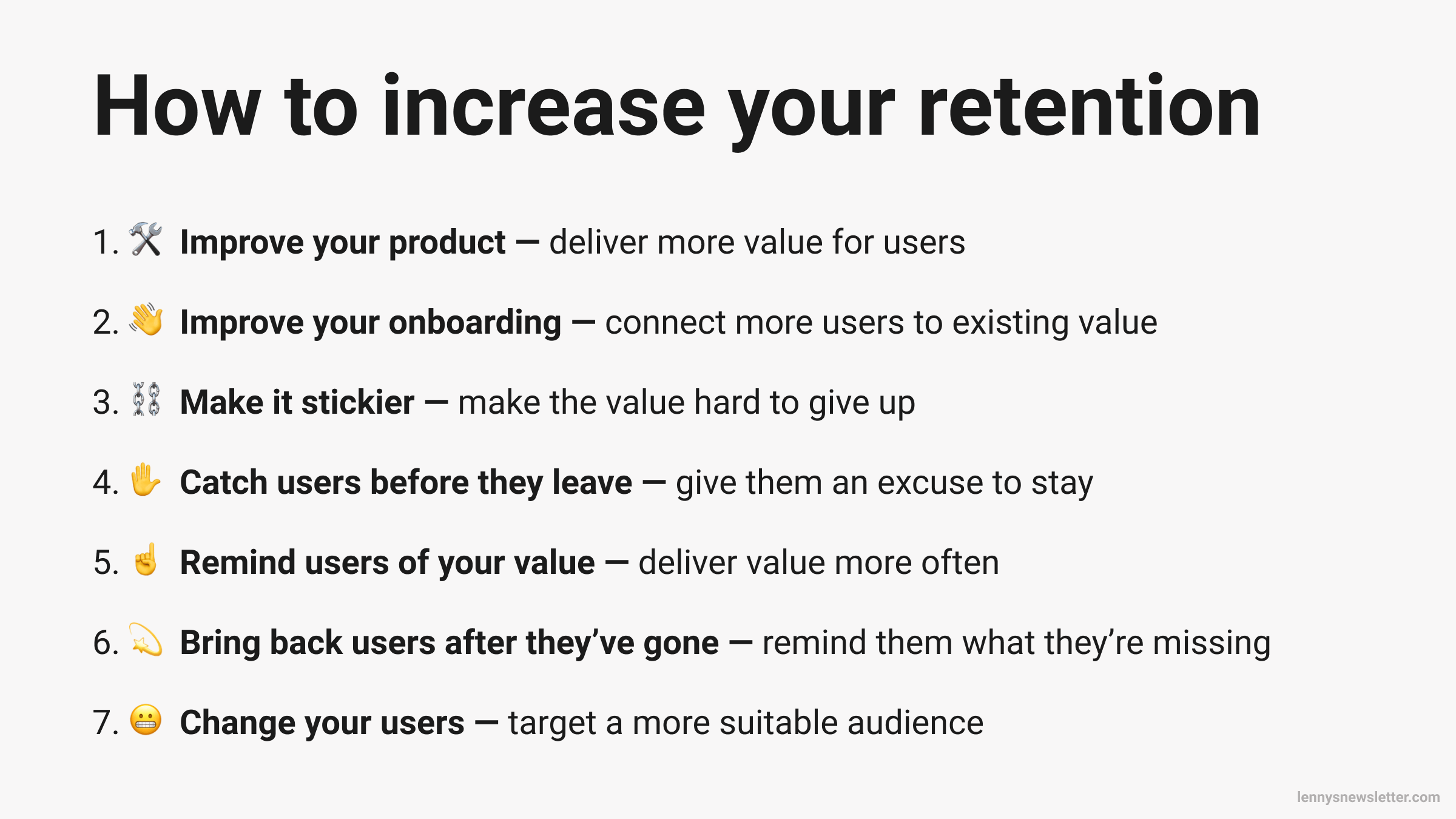
Here are the seven ways increase the rate of new users finding value in your product, and thus increase retention, ranked roughly in order of expected impact:
🛠 Improve your product — deliver more value for users
👋 Improve your onboarding — connect more users to existing value
⛓ Make it stickier — make the value hard to give up
✋ Catch users before they leave — give them an excuse to stay
☝️ Remind users of your value — deliver value more often
💫 Bring back users after they’ve gone — remind them what they’re missing
😬 Change your users — target a more suitable audience
Though not totally accurate, here’s a metaphor for what you’re trying to do:

Lenny Rachitsky@lennysan
Increasing your retention rate is like hosting a great party: 1. Invite the right people 2. Welcome them thoughtfully 3. Make sure they have a great time 4. Catch them before they bail 5. If they leave, show them what they're missing
11:45 PM · Aug 21, 2020
133 Reposts · 1.04K Likes
Let get this party started and dig in.
1. 🛠 Improve your product
This is at the very heart of retention. If you’re just starting out, much of your time should be spent here. “Build something people want”, as they say. Here are a few ways you can increase the value you providing to your users:
1. Solve your customer’s problem significantly better
Obvious, but important. How might you solve your customer’s problems 10x better? What are your users trying to do that you can make 10x easier? What would a customer’s ideal solution look like? Work backward from that.
Troy@tbols17
@lennysan After deep diving customer support cases, we learned users treated restaurant booking as a concierge. So we built a chat bot to make it feel more like a concierge service. Increased booking retention by ~30%
5:34 AM · Aug 13, 2020
1 Repost · 8 Likes
2. Solve more problems
How might you expand the breadth of the problem’s your solving for your customers? e.g. Uber launching many types of car services, Instacart adding Walmart, and Instagram adding Stories
Sebastien Provencher@sebprovencher
@lennysan Bundling many complimentary high-value products/services
4:52 AM · Aug 13, 2020
4 Likes
3. Make your product cheaper
How might you increase the ROI of your product?
Fabian Steuer@fabiansteuer
@lennysan Improving the pricing page and giving heavy discounts on longer subscriptions was the easily the quickest and most impactful change that drove (revenue) retention.
12:16 AM · Aug 14, 2020
1 Repost · 4 Likes
Christian Limon@cplimon
@lennysan A free gift and lower prices early in the users lifecycle. Users respond well to value.
2:01 PM · Aug 13, 2020
1 Like
Daniel Lopes@danielvlopes
@lennysan We didn't have a 1 thing, but many things. We spent the last 12 months consistently improving everything people complained about the product (lack of customization, navigation issues, lack of teams, etc). Lowering the price also had an impact on churn bigger than we expected.
6:41 AM · Aug 13, 2020
1 Repost · 2 Likes
4. Make it faster and more reliable
How might you make the user experience act (or feel) significantly better?
Brian Guenther | making 🤺🎮❤️@bguenther
@lennysan The best features tend to be the least sexy on a roadmap: - Reduce load times. - Reduce crash rate. - Eliminate friction in core flows.
7:39 AM · Aug 13, 2020
2 Likes
Nat Emodi@natemodi
@lennysan Improved speed. In our case, both product speed and delivery speed.
4:42 AM · Aug 13, 2020
6 Likes
5. Wait for network effects to kick-in
In businesses with network effects, like marketplaces (e.g. Airbnb) and social networks (e.g. Snapchat), the “product” becomes more valuable as more people use it. How might you bootstrap your network to get there more quickly for each user?
Andrew Chen@andrewchen
There's exceptions, though rare: 1) Activation is key. Setting users up to be successful means you can bend the curve early. (Earlier link above discusses) 2) For mktplaces/social, network density means retention improves as the network fills in But rarely just adding features!
8:37 AM · Aug 12, 2020
1 Repost · 22 Likes
6. Wait for the world to change
Sometimes it’s better to be lucky than good.

7. Pivot to solving a different problem
And finally, you may be better off pivoting to a different solution (or problem) if you can’t budge retention enough.
Jon Erlichman@JonErlichman
On this day in 2010: Check-in app Burbn raises $500,000 in its first financing. 7 months later, Burbn pivots and launches new app called Instagram. 18 months after that, Facebook buys Instagram for $1 billion.

8:59 PM · Mar 5, 2020
192 Reposts · 840 Likes
But note:
“The standard advice of listening to long-term customers who are already retained, and adding features for them— that doesn’t work. But that’s where most product teams spend their time. In my experience, the real levers to improve retention dramatically are in the experience for new users.”
— Andrew Chen
With that, let’s explore the lever that usually ends up being the most effective: onboarding.
2. 👋 Improve your onboarding
As Andrew points out above, and as I’ve myself experienced, you’re more likely to have an impact on retention when improving the new user experience, vs. improving the product. Why? Because, again, it’s very hard to invent (sustainable) new customer value — you’re lucky if you found one thing that people like. It’s much easier to get more people to experience the value you’ve already created.
Dan Hockenmaier@danhockenmaier
@lennysan Almost every big, lasting retention win I've seen came from improving the early user experience. Always within 30 days, and often within 7 days of signup.
7:37 AM · Aug 13, 2020
41 Likes
scott belsky@scottbelsky
pretty convinced: the first mile of your product's user experience will determine how it will end. 💀
3:08 AM · Aug 21, 2020
27 Reposts · 266 Likes
Dennis Xu@DennisHXu
@lennysan The biggest improvements to retention have come as we’ve gotten better at explaining the vision through the product - it’s given people an understanding of the prize they’ll eventually win if they continue to use it.
2:53 AM · Aug 14, 2020
4 Likes
Here are a handful of ways to improve onboarding:
1. Manually onboard new user
Superhuman is famous for their 1:1 onboarding strategy, but in reality, many companies (particularly B2B) start with a hands-on onboarding. Why? Because it’s a lot easier to get your message across person-to-person vs. through the product. Here’s an example from Airtable:
Zoelle Egner@zoelle
@lennysan Early on, we did proactive, personal outreach to people already inviting collabs at higher-than-avg rates to make sure they were super successful, getting lots of value, and onboarding new folks effectively. We turned insights from those convos into scalable resources for all.
4:45 AM · Aug 13, 2020
1 Repost · 47 Likes
2. Make sure new users experience your value
How much work, and how long, does it take for new users to experience the value that you provide? What keeps these users motivated to keep going? How could you cut that time down and keep their motivation up, without sacrificing the experience?
“The first principle we learned at Pinterest is that we should get people to the core product as fast as possible — but not faster.”
— Casey Winters, former head of growth at Pinterest
Some examples:
Mac@macintossh
@lennysan Identified most loyal users and the features they frequently utilized. Built a simple onboarding based on those specific features
10:38 AM · Aug 13, 2020
3 Likes
Marcus Jones@thebizmarcus
@lennysan Switched to a no credit-card flow in free trial. Now we don’t have people cancelling in their first 30 days after getting auto billed after free trial. The ones who sign up plan to stay
6:07 AM · Aug 13, 2020
10 Likes
Dan Hockenmaier@danhockenmaier
@lennysan Examples: - gathering more preferences about users in signup flow to nail starting media recommendations - bundling related products into the post first order experience - Serving extra impressions to high potential supply in their first [x] days on a marketplace
7:38 AM · Aug 13, 2020
25 Likes
3. Increase the odds new users have a great time
What are all of the ways that your users set themselves up for failure? How can you proactively help them avoid this?
“The users of your product don’t want to make choices, especially when they are in the first mile. The default options you provide, like which tab they land on and pre-populating fields with suggested selections, make all the difference in pulling new users through the first mile.”
A few examples:
Akshay Pruthi@PruthiAkshay
@lennysan 1. Focusing on loop completions. I was working on a sleep app. We discovered, 20% of the people download the app in the mornings and afternoons. So we ask them to set a bet time alarm which will remind them to come on the app at the right time and listen to sleep music. +7% inc
11:15 AM · Aug 13, 2020
17 Likes
Bryan A. Davis@thebryandavis
@lennysan Can't overstate the importance of a proper onboarding plan that gives new users/subscribers a view of what they signed up for.
7:01 AM · Aug 13, 2020
3 Likes
Robbie Allan@robbiedigi
@lennysan Reorganizing the onboarding experience to relate directly and specifically to the claims on the marketing site and making these as visceral as possible (instead of a series of technical how-to-get-set-up steps)
6:11 AM · Aug 13, 2020
1 Repost · 14 Likes
4. Get more users through the flow
And finally, you can’t retain users if they don’t make it through your onboarding, so look for ways to reduce friction, reduce distractions, and increase motivation. For example, a ✨ can go a long way:
Ryan Hoover@rrhoover
@lennysan @hnshah Back when I was working in gaming a decade ago, we built tech to make games playable in the browser, embedded on other websites. We added a simple shimmer effect to the PLAY button which increased view to click dramatically. (I don’t remember the exact number but I think 2-3x)
6:18 AM · Aug 13, 2020
106 Likes
VisualStoryCo.@CoVisual
@lennysan We had mandatory and non mandatory fields to complete a transaction. We removed 2 non mandatory fields completely off the journey. Increased retention.
9:09 AM · Aug 13, 2020
2 Likes
Michael Sutyak@msutyak
@lennysan Hyper personalization and simplification of what users are shown. Choices create panic and customers leaving.
1:54 PM · Aug 13, 2020
4 Likes
3. ⛓ Make it stickier
The next most common tactic to increasing retention is make your product hard to give up. Some approaches:
1. Build habits
Give users an extra nudge to revisit the value you’re creating. Long-term though this only works if you are creating real value for people.
Cem Kansu@cemkansu
@lennysan Addition of the streak mechanic on Duolingo. The streak = number of consecutive days you’ve practiced a language on Duolingo. Helped create very strong daily habits.
6:18 AM · Aug 13, 2020
2 Reposts · 39 Likes
Tanmayi Sai@tanmayis20
@lennysan Time based rewards system leveraging engagement . Saw ~ 400-500 bps change in weekly retention. There’s probably more impactful features out there but this is one tactic
4:50 AM · Aug 13, 2020
3 Likes
Andreas@ndreaslarsen
@lennysan Beverage subscription: Switched from selecting a ‘Delivery Date’ to a ‘Delivery Day’ (Monday - Saturday). A certain day of the week makes habit formation quicker, easier to plan > increased retention ~20% for the cohort we launched to (still a WIP)
7:34 AM · Aug 13, 2020
15 Likes
2. Create incentives to come back
Amazon Prime and loyalty programs are also great examples of this lever in action because they give your customers an incentive to continue using your product over other options.
James Gulland@jamesgulland
@lennysan Adding a loyalty scheme, with associated discounts/offers, which got greater with continued usage. Customers loved it, and smashed all targets.
8:34 PM · Aug 13, 2020
2 Likes
3. Sign annual plans
“One portfolio company spent years trying to improve churn. The most important lever was shifting 70% of new cohorts to annual.”
— Kyle Poyar, VP, Growth at OpenView
4. Deeper integration
The more integrated your product is into a person life, or an organization’s workflow, the harder it is quit. For example, Slack (just try taking it away), AWS (just imagine the switching costs), and WhatsApp (all your friends are there!).
No matter how sticky you make your product though, users will still leave. Next, let’s look at ways to catch them before they do.
4. ✋ Catch users before they leave
Though often done badly…
shawn swyx wang@swyx
@lennysan Every newspaper, every cable company, every phone company CEO: "let's remove the unsubscribe button from the website and make them call a busy automated phone line during business hours to cancel. And then give them a bunch of upsell questions to change their minds."
7:34 AM · Aug 13, 2020
1 Repost · 5 Likes
…it’s worth spending some time on your de-activation flow. Some users may not actually want to quit forever or have an issue that you can solve before they call it quits. Here are some of the more effective ways to keep your users from leaving.
1. Let users “pause” or “snooze” instead of cancel
One of the more successful experiments we ran at Airbnb to reduce host churn was to give hosts a way to “pause” their listing, instead of removing it. This gave them time to deal with whatever they needed to deal with and then easily come back when they were ready. Here’s another example of this with Hulu:

2. Give users an incentive to stay
Sometimes a short-term cash crunch is forcing a customer to leave, and a bit of leeway there keeps them as a customer.

3. Ask users why they’re leaving, and offer a solution
See if you can address the issue in-line.
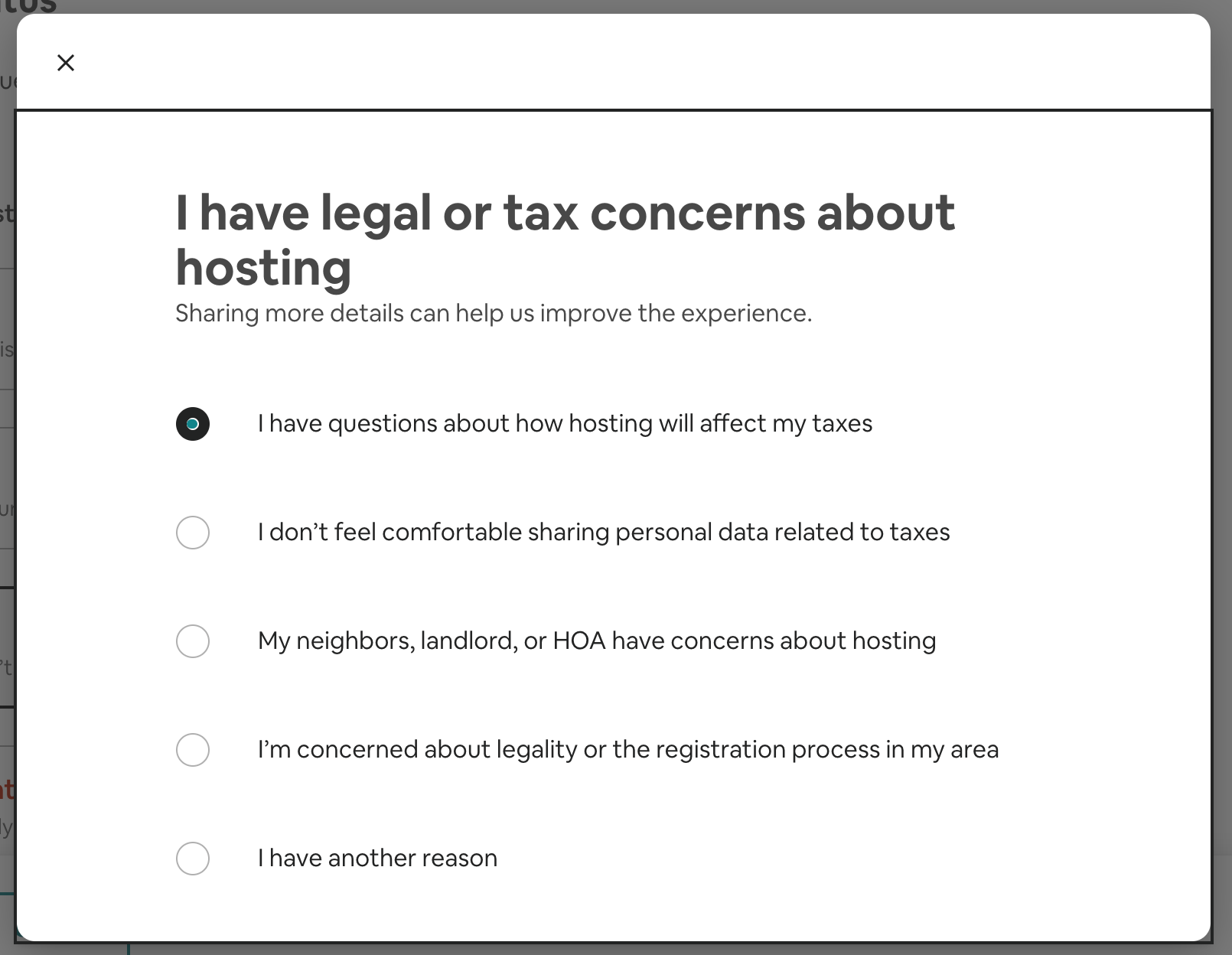
4. Remind users of the value they’ll lose
There’s a reason your users decided to join — this is a good time to remind them of what they’ll miss. But, be thoughtful in how you approach this. It’s easy to go too far.

5. Predict churn and try to avoid it
And finally, the holy grail of retention – predicing and avoiding churn. I haven’t personally seen anyone successfully do this in practice, but it’s worth exploring if you can find some strong indicators of dissatisfaction.

5. ☝️ Remind users of your value
Even when you do provide great value to your users, they may not actually find or remember it. Look for ways to remind them. This can be over email/SMS, in-product, or an occasional call.
Some examples:
Markos Tsirekas@MTsireud
@lennysan We added a morning brief to our therapist's calendar with deep links to quick product actions. Reminded them repeatedly always what they're missing out on via a brief which provides value either way. Sent at 7am, always.
4:58 AM · Aug 13, 2020
5 Likes
constantinou@constantinou
@lennysan Increase entry points (widgets, share sheets, browser extension, notification). Be present in more places. Leverage platform capabilities. Widgets had a double digit retention improvement. Coming back with iOS 14.
2:36 AM · Aug 17, 2020
1 Like
Brian Cristiano@boldceo
@lennysan 1:1 outreach to every customer. Every month. Unannounced. Ask the questions “how’s it going?” & “what could we be doing better”
9:29 AM · Aug 13, 2020
2 Likes
6. 💫 Bring back users after they’ve gone
Though rarely a huge lever, it’s worth thinking about ways to pull back users who at one point found your product interesting. You can do this with ad retargeting, calls, or email/SMS, for example:
Wilson Sadowski@Wilson_Sadowski
@lennysan We launched a tool for automatically recovering churned customers via SMS today. @ProfitWell Retain can’t hurt! https://t.co/YiuEohPAYy

Patrick Campbell @Patticus
Not so humble brag: We've now recovered over $250M in churn (billions in LTV) for our #DTC and #SaaS customers. Cool announcement: We just launched SMS churn recovery as part of the ProfitWell Retain suite. Here's more about credit cards + SMS than you ever wanted to know 👇 https://t.co/kubyWQ17LY
7:46 AM · Aug 13, 2020
3 Likes
7. 😬 Change your users
And lastly, an often-overlooked element of retention rate is the quality of the users you’re bringing in. These users can have little-to-no intent to purchase, or can simply be the wrong audience for your product. Shifting either one of these could have a profound impact on your retention rate metric.
For example, paid users (e.g. FB ads) are notoriously the lowest intent traffic. Cutting back on paid traffic will increase your retention. Obviously, this won’t automatically translate to a much healthier business BUT it will impact your economics and thus it’s important to look at.
ChenLi Wang@chenliw
@lennysan Cut your marketing spend and stop acquiring lower quality/lower retention users
7:16 AM · Aug 13, 2020
14 Likes
Along the same lines, you may also find that your early target users/customers just don’t need your product badly enough. It happens. Instead of giving up, zero in on the users who do retain. What makes then different? What do they find valuable? How do you go find more of those types of users, and build for them? This story about Superhuman’s search for PMF is an excellent example of this in action.
Henrik@henrikberggren
@lennysan Be more crisp with who your product is for and stop marketing to everyone else
7:20 AM · Aug 13, 2020
5 Likes
In summary
I hope the list of seven strategies above gave you some new ideas to improve your own retention rate. Though this is not an easy road, it’s a trek worth taking. For reference, here’s a summary again of the tactics to explore:
Recommended reading
Do You Have Product-Market Fit? It's All About Retention by Casey Winters
Why Retention Is The Silent Killer by Brian Balfour
What Is Good Retention: An Exhaustive Benchmark Study with Lenny Rachitsky by Casey Winters
Retention is King by Jamie Quint
Crafting The First Mile Of Product by Scott Belsky
Why Onboarding is the Most Crucial Part of Your Growth Strategy by Casey Winters
From conversion to retention: industry experts on improving your onboarding
If you’ve found other tactics to be effective in your product or business, I’d love to learn about them. Just leave a comment or reply to this email.
See you next week!
🔥 Job opportunities
Product: KUDO, Uptime2020
Design: Cascade, Invest Like The Best, Pachama, Runway, Sourcetable, Stytch
Backend engineer: Sourcetable
Fullstack engineer: Centered, Icebreaker, Invest Like The Best, Runway, Snackpass, Wren
Ops: Levels
Community: Outschool
Content: Levels
HR: Cerebral
🧠 Inspiration for the week
Watch: Try not to smile
Read: Anxiety Is the Dizziness of Freedom by Ted Chiang — One free chapter from his incredible book Exhalation
If you’re finding this newsletter valuable, consider sharing it with friends, or subscribing if you aren’t already.
Sincerely,
Lenny 👋